Ready to Ace Your Exit Interview?

When I’m having a management or a mentoring conversation, I like to pose the following challenge: “You just got offered an amazing new job .. it’s one you’ve always dreamed of.  But before you leave, you have an exit interview with your manager and your successor.  What do you want to tell them about your tenure, your team, and your projects?  What burning issues will your successor inherit and are they on track to being resolved?”

The answers depend, of course, on the nature of your current role.

  • If you are a manager, you probably want to talk about what a great, high morale team you have.  How the people are on a good trajectory, or how you are working with the ones who aren’t to get on a clear path for addressing the problems.  How you have a strong bench of future leaders you’ve been developing (hopefully your successor is one of them).  The mission is inspiring, the goals are clear and reflect the biggest opportunities available, the strategy is compelling, and the execution is effective.
  • The projects that you are responsible for are on a great path to success.  As you leave, things will continue seamlessly forward because the work is well organized and you have made sure that it an be passed over cleanly to somebody else.  No commitments will be missed, no balls dropped.
  • The issues that potentially block success have been analyzed and are being addressed and/or mitigated.

If you can say all that, congratulations on having aced your exit interview!  The person who is taking over for you is truly set up for success, but they have some big shoes to fill.

*****

Is that how it’s going to go?  If not (and I have yet to meet anyone who says it will!), what are the biggest reasons you won’t be taking a victory lap at your exit interview?

Usually, I find that there are a handful of big issues that people are worried about and that aren’t on a good track to resolution.  They might be:

Unpleasant.  People problems often fall into this bucket.  Sure, things aren’t great, and yes, something really ought to be done about it, but dealing with it is going to suck.  It’s often doubtful whether there will be a clear resolution at the end, especially if the other person doesn’t work for you and hence you have limited options for adjusting the situation.   So, it’s easier to just avoid the whole thing and keep bumbling along.

Important but not urgent.  Creating that new market would be an amazing win for the company.  Hiring a senior architect could transform the ability of the team to build great software.  But there is no particular urgency – no deadline will be missed, there is no forcing function.  And there are a hundred emails to answer, and that milestone is coming up, and my schedule is packed, and …

Hard.  I know that I should really be working on this big issue or opportunity, but I don’t exactly know how to do it.  I have to go get educated in some new area, or break through a tough analysis, or learn a new skill that I secretly fear I’ll be lousy at.  One way or another, it’s going to be a ton of work, and I’m not sure that I’ll really get anywhere, and my plate is full of things I do know how to do.

I’ve found that these big issues that people feel bad about are often the most important things they should be focused on.  So, I get them to write down the list of those issues, and then I ask the key next question: what specific actions are you going to take about each one, and when?  Because feeling bad doesn’t accomplish anything .. you need to take action.  I keep track, too, and the next time we talk, I bring it up again to see whether there has been progress.

Are you ready to ace your exit interview?  Why not?  What are you going to do about it?

Do You Want To Work For You?

So here’s your challenge: you just got a new manager and it is … yourself.  How do you feel about that?  I think it’s a good test to figure out what managers are for, and how to be a better one.

Say you are Worker Bee, pounding away on a daunting array of projects.  And your new manager is Fearless Leader, who happens to be your exact clone.

Are You Happy?

If you aren’t happy and excited about having yourself as your new manager, you should think really hard about why not.  Mostly, those reasons are things you need to fix, because they will bug other people who might work for you, too.  And no, you aren’t so fabulously special that you need a different kind of manager than all those “normal” people.

A reasonable sounding answer (that I think is bogus) is that you want a manager who is much more experienced and senior than you are, so you can learn from them.  Sure, maybe, but there is a good chance in life that you will be managing people who are just as experienced as you are, or more.  So you’d better find ways for managers to add value, even when you aren’t wiser and more expert than the team, or there are going to be a very limited number of management roles you are going to be good at.

You Won’t Be Clones For Long

One of the interesting side effects of a new role is that it inevitably changes your perspective .. and it happens much more quickly than you’d think.  As Mark Twain says, “You tell me whar a man gits his corn pone, en I’ll tell you what his ‘pinions is.”

Worker Bee will start grumbling that Fearless Leader doesn’t understand how difficult some of the challenges are in getting the key projects done on time and needs to back off.  Fearless Leader thinks that Worker Bee is mired in the details and just can’t get with it on the big picture.  Why can’t he understand what is really important, and why does he keep going dark on key issues and leave me, Fearless Leader, out of the loop?  And so forth.

That’s both good and bad.  It means that you will each have to do some work to understand the other’s point of view, but it is also the key that will solve our puzzle.

How Does Fearless Leader Add Value?

There is some notion that managers are supposed to be wiser and more skillful than the people working for them.  But often, they aren’t.  And especially as you get more senior and manage larger teams, it’s pretty much impossible to be better than all of your direct reports at their job.  You will have people working for you with years or decades of experience and deep expertise in their fields .. fields that you often know little or nothing about.  At an extreme, a CEO is very unlikely to be a better engineer than the VP of engineering, a better marketer than the VP of marketing, AND a better salesperson than the VP of sales.  But the CEO is still supposed to lead the team and add value, despite being (often) incapable of doing their job.

In our thought experiment, Fearless Leader is fortunate enough to start out exactly as skillful and capable as Worker Bee.  But, he adds exactly zero value from his additional expertise – he hasn’t got any.  In fact, very shortly he’s going to know less than Worker Bee.  He’s going to meetings (maybe useful ones, or maybe about exciting things like “building an empowered team and enhancing manager capability”) while Worker Bee is writing code or designing products or whatever it is that he or she does.  Fearless Leader’s “doer IQ” will probably be on a steady slope downward, especially if Fearless is a good manager and keeps getting more responsibility.

The more cynical among us might say that Leader’s job is to “do no harm” while others get the job done.  But that is selling the job of manager too short – there are a lot of ways that they should be helping the team:

  • Clearly articulate the mission, strategy, and execution plan.  Since we know that Fearless has no lock on expertise in the team, they aren’t supposed to be the all-knowing sage.  In fact, they generally will not (can not) be the most knowledgeable person about the details of most issues.  Sometimes the answers are defined by somebody else – maybe Fearless’s manager has made it clear what the mission of the team is.  Fearless might not be a programmer but has a lead developer who owns the coding plan and schedule.  Exactly how the mission and plan are determined can vary all over the map – that’s fine.  The thing that Fearless must do is make sure that there is a clear plan, that it has been appropriately validated, and that everyone who needs to know is kept informed.
  • Be a channel of communication up and sideways.  Fearless is in meetings with people up the management chain and in other teams, while Worker Bee is heads down getting things done.   Fearless should be acting as a communication network up, down, and sideways .. representing the team, getting information about what’s going on elsewhere, and bringing it back.
  • Be a fair advocate.  When people are being evaluated, Fearless needs to be a strong but honest advocate.  He or she needs to make sure that everyone in the management team understands the performance of the people on the team, that compensation and promotion are being handled well, and so forth.
  • Be a great coach.  As the manager, Fearless is “watching the movie” that Worker Bee is acting in.  Just like you get a totally different experience (often uncomfortable) watching a video of yourself , Fearless is in the audience for Worker Bee’s movie.  That puts Fearless in a great position to give honest feedback, push Worker Bee to go beyond the comfort zone, and hold Worker Bee accountable.  The best tennis or basketball players in the world have coaches, whom they could generally crush in one-on-one competition .. but still get tremendous value from.  It may be harder, but you can be a fantastic coach without being better at the activity than the person you are coaching.

These are things that I believe managers should be great at, regardless of whether they are more experienced than the people working for them.  Master them, and I think you will be able to say honestly that you’d be a great manager for yourself.

How do you stack up?

Create Every Day

I have always been passionate about making things out of ideas.  One of the great joys is to start from a whim or a flash of inspiration, breathe life into it, make it real, and share it with others.  Drawing, photography, writing, cooking, startups – they all begin as a spark or sometimes a compulsion.  They take form through art and craft and passion, and eventually emerge on some trajectory .. sometimes they soar, sometimes limp, sometimes fall to the earth with a thud.  They don’t always deliver on their early glittering promise.  They can morph in strange and unforeseen ways, yielding the delightfully unexpected or the disappointing or the just plain weird.

I write about that compulsion in a blog about inspiring teams and achieving goals, because the desire to create is one of the oldest and strongest human needs.  We have an accompanying penchant for destruction, unfortunately, but out of the fire and ashes we always begin again and go on to even greater acts of creation.  If you can get a team to commit whole-heartedly to some shared act of creation, the result can be magical.

The idea is the beginning.  It can be flickering and unformed, or it can spring forth almost fully shaped.  It often comes at odd times when my mind is drifting.  I try always to keep a journal nearby and scribble in it often, filling it with fragments and half-glimpsed visions.  Just writing down the beginnings of an idea often starts me along the path.

The pages are still blank, but there is a miraculous feeling of the words being there, written in invisible ink and clamoring to become visible.  – Vladimir Nabakov

Then comes that moment when you have to begin the work.  That can be hard; you aren’t inspired, you aren’t in the mood.  Your tools feel awkward and balky – they don’t fit your hand.   You know that what you are making will be clumsy and lifeless.  In your mind you saw glittering potential, yet here is this pale, lifeless thing that petulantly takes shape in front of you.  You question why you bother, who needs the hassle, it’s all pointless.  Maybe I should go pay some bills – at least then I’ll have done something useful.

But sometimes, it happens.  From somewhere outside your conscious control, the work takes on a form and shape of its own, and you feel that you are the means and not the maker.

It seems to me that those songs that have been any good, I have nothing much to do with the writing of them.  The words have just crawled down my sleeve and come out on the page.  – Joan Baez

It’s a magical feeling, and it has produced some of my favorite results.  I was leafing through a book of portraits, and was absolutely struck by one of Samuel Beckett, the playwright.  He looked just like an Old Testament prophet, his craggy face filled with the marks of a long life, his eyes piercing – I could feel the weight of that stare, the rough texture of the skin.  I wanted to build that up, layer after layer, smearing the graphite with my hands to connect with that tactile sense in my brain.

When I look at the drawing, I remember the feeling of shaping the skin and picking out the pupils of the eyes.  I don’t know exactly how it turned into those marks on the page.  But I see what I felt when I looked at the picture.  I can pick out the technical flaws, but what matters to me is that I captured what I wanted to express.  The moment when you feel like you have broken through, at least for the moment … bliss.

But will it happen again?  I think that’s why artists can be so superstitious, with their muses and their rituals.

After waking up at 5 AM, poet Maya Angelou heads to a nearby hotel with legal pads, a bottle of sherry, a deck of playing cards, a Bible and Roget’s Thesaurus. Per her instructions, hotel staff members have removed all the art and photos from the room’s walls. Before leaving in the afternoon, Angelou usually completes between 10 and 12 pages during her stay, which she edits later that evening.

American writer John Cheever wore his only suit of clothing each morning as he rode the elevator down to a basement room where he worked. Upon arriving there, he would undress to his underwear, hang up his suit, and get to work. He would dress to go back upstairs for lunch and again at the end of his day when he would ride the elevator back home.

In addition to the enforced discipline of a ritual, it seems like they are trying to recreate the conditions that have brought the visitation upon them, because what if it never happens again?  What if it abandons you, leaving you sweating and struggling on your own, forcing out work that can never be as good as what came before it?  To be left staring glumly at a blank sheet that refuses to fill itself with prose breathing life, or a drawing imbued with its own spirit.

I manage to keep my clothes on and work at home .. though perhaps I’d be a better artist if I reconsidered?  I have learned that the only way I can tempt that inner spirit to come forth is to sit down, take a deep breath, and dive in .. even when the water looks cold and dark and uninviting, when there are a hundred other easier and more comfortable things to do. I try to create something every day, however small or incomplete, even when I’m not in the mood.  It’s like exercise – you don’t always feel like doing it, but once you start, you often get swept up in it.  I think it is exercise .. for the brain, and it takes just as much discipline to make yourself start.

You can sit there, tense and worried, freezing the creative energies, or you can start writing something. It doesn’t matter what. In five or ten minutes, the imagination will heat, the tightness will fade, and a certain spirit and rhythm will take over. – Leonard Bernstein

You must write every single day of your life… You must lurk in libraries and climb the stacks like ladders to sniff books like perfumes and wear books like hats upon your crazy heads… may you be in love every day for the next 20,000 days. And out of that love, remake a world. – Ray Bradbury

What are you creating today?

Are You Falling for the Old “Scooby Snack” Trick?

Remember Scooby?  He’ll do just about any dangerous, scary, unpleasant task that needs to be done, if he can get a Snooby snack or two out of it.  The Scooby snack is a classic example of “extrinsic” motivation – something external that you want.  At work, companies set up all kinds of carefully designed extrinsic motivations – money (bonuses, raises), status (levels, titles), and perks (nicer offices, first class travel).  Their goal is to get you to throw yourself into the work that the company needs to get done, regardless of how fulfilling you find it.  They are happy if you find yourself fulfilled, too, but the system is designed to encourage you to work hard even if you aren’t.

But isn’t that how the world works?  Isn’t the basis of capitalism the desire to better your situation?  Extrinsic motivation certainly works, up to a point.  However, the story is a bit more complicated than that.  We strive to get rewards, but often it isn’t purely about their absolute value.

The Drive for Status

As a species, we’re acutely conscious of our social status.  There have been a number of really interesting studies showing that more money is not the key to happiness after a certain point .. but that making less money than the people around us (regardless of income level) makes us unhappy.  In general, our status is more important than the absolute amount of money we make.  For example, one study examined 12,000 adults in Britain, ranking people based on geography, age, income, and educational level.   “Boyce and Moore found that an individual’s rank, viewed this way, was a stronger predictor of happiness than absolute wealth. The higher a person ranked within his age group or neighborhood, the more status he had and the happier he was regardless of how much he made.”

This focus on status makes a lot of sense when you consider that pre-historic humans were essentially dead if they weren’t part of a group, and that their ability to survive and have children was heavily dependent on their status.  The symbols of success or failure have evolved, but our basic drives have not changed (as you can see in Status Anxiety, Alain De Boton’s fun and thought-provoking book).

All of this research is good background if you decide that you are going to settle for extrinsic motivation – you might as well make sure that you pursue the things that will give the most happiness.  For example, you might be a lot better off hanging out with a different crowd rather than scrabbling for that raise or buying a fancier car.

But I think a much more interesting challenge is to focus on a different model – trying to find an environment that fosters your intrinsic motivation instead.

Motivation from Within

Think about the projects that really made you happy – at work, at home, at school, wherever.  When you were doing them, you couldn’t wait to dig in again.  They are the times you look back on with the most satisfaction.  What do they have in common?  I’m going to guess that it wasn’t the size of your weekly paycheck, the car you drove to work, or the title on your business card.  Those moments in your life are giving you valuable clues as to what really inspires you.

For me, the recipe is pretty simple:

  • I think that what I am doing is new and important
  • I have great people to work with
  • We are all pushing hard to achieve something together as a unified team
  • I am contributing in some meaningful way to the project

That’s pretty much it.  Or, as I like to say, “I want to be with people who inspire me, obsessing together over something worth obsessing about.”  If a project has those things going for it, I’m probably going to be happy.

There is also evidence that people do better work when they are intrinsically motivated.  For an entertaining walk through some of these ideas, try this presentation by Daniel Pink (who also wrote a book about the subject called Drive).  I find it really intriguing that, for a whole range of experiments, larger monetary rewards produced poorer results.  His argument is that there are three key things people seek: autonomy, mastery, and purpose.  He talks about how this model helps explain the open source software movement.

My own experience is pretty consistent with this model.  For me, autonomy shows up in two ways.  The most important one is that the team feels that it can do what needs to be done.  That’s often hard within large organizations, and was a significant frustration for me when I worked in one.  It’s one key reason why startups can be so fun – they don’t have much in the way of resources, but they certainly have a lot of autonomy!  Personal autonomy is less important to me – I like working closely with others and am happy to adapt my ideas if there are others around who are making them smarter.  Maybe I’ve just been lucky, but I’ve found that as long as the right people are involved, personal autonomy hasn’t been a big problem.

Purpose is crucial.  I have to believe in the project and that it is important.  I may be wrong, or others may believe that I am delusional .. that doesn’t matter.  What matters to me is that I believe it.

Mastery is also a core goal – I want to contribute to the project in some deeply important way by being excellent at something.  Ideally, I’d like to be great at some part of the work (so I add value right away) and I want to build mastery in other skills I didn’t have when I started.

What Motivates You?

I’ve had this conversation with many people, and most of them never sat down to think about their real intrinsic motivations.  Maybe autonomy, mastery, and purpose is it for you .. or maybe your answer will be different.  The key thing is to figure it out.  Otherwise, your employers will be happy to provide an endless supply of organizational Scooby snacks for you to covet and pursue.  Are you settling for that?

Cracking the Nut (Part 4) – Wrapping it Up

It’s time to get this decision landed.  What’s Slimy going to do?

Defining the Possible Solutions

Early in our project, we came up with a list of possible options for competing with BigSludge.  By this time, with all the discussion and analysis, we’re ready to update that list.  We’ve refined some of them, maybe some have crumpled under their own weight, maybe we have some new ones.

In our case, here is what came out of our investigations:

  • Direct head to head competition in their core markets looks like a losing strategy.  We went and talked to people on the front lines, we talked to some customers we’d like to convince to use our industrial slime, and we mapped out what kind of return we’d get from additional spending on marketing and sales.  It all looks lousy.  BigSludge is entrenched, they have relationships we can’t disrupt, the market is pretty locked in, and our products aren’t different enough to give us a unique value proposition.
  • We found some intriguing sub-markets where we are doing really well.  We’ve gotten serious traction selling slime for cleaning the grime out of industrial manufacturing machines.  And, you can cover buried power generation plants with it to reduce temperature fluctuation and do weather proofing.  BigSludge has no presence in those markets and our products work much better for these uses, so our specialized slime offerings are growing quickly and have a good head start.
  • The kid market for prank slime looks like a potential winner.  We’ve tested our slime out with kids, our test version is flying off the shelves, and it’s showed up in a couple of edgy TV shows as the Next Big Thing.  Word of mouth is strong.
  • The kid market will take several years to develop.  Based on every precedent we’ve looked at, it just isn’t possible to grow a large new toy market quickly.  No product we looked at that relied on selling through retail channels was able create a new category and grow to a large size in less than five years.

So our updated options are:

  1. Aggressively pursue the specialty commercial markets
  2. Aggressively pursue the kid market
  3. Do a blend of both

The next step is (yes, you saw this coming) to write them down.  We put together a summary for each:

  • Define the option in one page.  Capture the intuition for it, and keeping it short forces us to stick to the essentials.
  • What’s the plan – outline how we’d execute on this idea in very concrete terms.  Milestones, key steps.
  • What you have to believe.  I learned about this approach from a class I took on strategy, and I’ve found that it is a really useful way to capture the key assumptions for a particular option.  You write down the key things that you have to believe in order for the option to be viable/optimal:
Option What you Have to Believe
Pursue specialty commercial markets Slimy can make enough revenue from these markets to sustain our growth needs and can protect our position from BigSludge and other competitors.
Pursue kid market The market is big, viable, and will develop quickly enough to compensate for relatively flat growth in the core business.
Pursue both Slimy Inc is capable of effectively carrying both initiatives forward at the same time (resources, time/focus of management team).  And, the kid market will be slow enough to develop that we need some nearer term revenue.

Evaluating the Options

By the time you have written down the options in more detail, sometimes you will find that the decision basically makes itself.  It is obvious to everyone that one makes the most sense and you are done.  That’s a nice outcome.  But let’s assume we aren’t so lucky; how are we going to decide?

The next thing I do is to assess every option against every one of the criteria we came up with in part 2 (link).  There are two basic ways to go after this – quantitative and qualitative.

Quantitative – if you want, you can create a precise mathematical model to weigh your options.  You can build a spreadsheet with a numerical value for each of the criteria against each option and a weighting factor per criterion.  Then the spreadsheet will happily compute a score for each option, and the highest score ought to be the answer, right?  I’ve done that before, and it has been useful on occasion, but I think it generally gives a false sense of precision to the exercise.  Your tidy spreadsheet full of numbers and formulas can leave you convinced that you are engaged in a scientific analysis.  But you aren’t, really.  At the end of the day, you are making a decision based on (informed) guesses about the future and intuitively chosen priorities.  So I usually don’t bother to build that spreadsheet.

Qualitative – what I generally find more useful is to assign a rough score (maybe 1/2/3 or A/B/C/D/F) to each option for each of the criteria.  Have a justification for each score, so you don’t spend all your time arguing about B’s vs. C’s when people look at the table.  Then eyeball the result and you are in a pretty good position to decide, or to have the debate among the decision makers if it isn’t up to you.  The Slimy, Inc table might look something like this (note that we updated our criteria a bit):

  Specialty commercial Kid market Both
Medium term revenue (3 yrs) A C B
Long term revenue (5-10 yrs) B A B
Risk of revenue projection B D C
Ability to execute A C D

It might seem much too simplistic at first to distill many, many hours of analysis and detail into a little chart with A/B/C/D on it.  But I have found that there is remarkable power in simplicity.  It’s like the old line about writing a shorter letter if you had more time.  Having to summarize a mountain of analysis in a very succinct form forces you to commit.  Complexity is often a security blanket against making a hard call – as long you as you can say “on the one hand, on the other hand”, you can avoid making a decision.  By committing to the values in the table, it gets you in the habit and helps walk you towards the harder ultimate decision that you are trying to make.

And now that you have all the analysis done, and summarized .. get whomever you need in a room, and DECIDE!

Conclusion

I hope that this approach to analyzing issues has given you some tools that you can use the next time you are confronted with a difficult decision.  Use as many or as few of the tools as you need .. in some cases, as in Part I, you might just pick a couple of them.  Other times, when facing a really complex and involved question, you might need to throw the kitchen sink at it.

Remember that no tool or approach will make a tough decision for you – that’s your job.  And a hard decision will stay hard no matter what.  But a framework like this one can let you approach it with what I like to call systematic subjectivity – you make your judgments in a systematic and thoughtful way that helps you wade through unknowns and emotional entrapments.  Good luck!

P.S.  Slimy decided to aggressively pursue the specialty commercial markets.  They will continue to incubate the kid products to see whether they get further traction.

What is Your “Super-Power”?

It’s a skill that has always come easily to you and you wonder why other people seem to struggle so much to master it.  Your team automatically looks to you when it is needed and assumes that you will be the one to do it.  You invent new and creative angles while you are daydreaming in the shower.  When you look back on a project, the times you were exercising this skill are the times that come most vividly to mind.  You feel like you are flying when you are using it.

These are all clues that can help you find what my old team called your super-power.

What Does a Super-Power Look Like?

Your super-power might be something that people are used to thinking about – you are amazing at playing the piano, or speaking in public, or throwing a ball.  But it might be something much less obvious.  There are many, many different kinds of things that people excel at.  While our society celebrates remarkable skill in athletics or performance, I love to look for and to be inspired by unusual intellectual achievements.

For example, I’ve known some truly amazing programmers.  I was one of the best coders around when I was an undergrad .. and then I met these people, who just utterly crush me in their ability to construct large systems at seemingly super-human speed.  I worked with one of them who could hold tens of thousands of lines of code in his mind; he could see instantly how to create some new feature or modify the design in a fundamental way.  I could work through the system and build up the knowledge in my head to get to the same goal, but he had the whole system on tap and immediately saw the solution.  No amount of practice on my part would ever leave me able to match him at that particular skill.  It was his super-power.

Richard Feynman was a brilliant Nobel Prize winning physicist who wrote a set of highly entertaining stories about his life.  One of my favorite anecdotes was about his use of visual metaphor to grasp deeply complex abstract ideas.  He would use this to test new topology theorems:

For instance, the mathematicians would come in with a terrific theorem, and they’re all excited.  As they’re telling me the conditions of the theorem, I construct something which fits all the conditions … the balls turn colors, grow hairs, or whatever in my head as they put more conditions on.  Finally they state the theorem, which is some dumb thing about the ball which isn’t true for my hairy green ball thing, so I say, “False!”

He was famous for creating visualizations of abstruse ideas that would let you use intuition rather than mathematical formulas.  Other physicists would be laboriously building up their mental models using mathematics and other abstractions and he could leap to insights that they could never have gotten without hours or days of contemplation.  Now that’s a cool super-power.  But it isn’t one that most people would think of as a “skill”.

I hope these examples encourage you to look beyond the obvious and find the skills where you really stand out.

Investing in Your Super-Power

Even if you are naturally great at something, you have to hone it.  Michael Jordan was legendary for ruthlessly pushing himself to practice and prepare harder than anyone else.  If he had settled for a pickup game or two every week, he’d never have become the incredible player that he was.  Louis Pasteur said “Let me tell you the secret that has led me to my goals: my strength lies solely in my tenacity.”  There are many, many similar quotes from people who have accomplished great things.  It is consistent with recent scientific studies, popularized by people like Malcolm Gladwell and Geoff Colvin, that magic happens when a talented person uses deliberate practice to develop a skill for 10,000 hours.

But if you are going to invest that kind of time and effort into something, you’ll get a much better result if you are betting on something you excel at.  Lots of people are pretty good at lots of things .. you’ll achieve a more distinctive result if you invest massive time and energy in something that you are remarkably good at.  And, you’ll be much more likely to stick with it, if you enjoy it.  So I believe that one of the great quests is to find those things and to design your life to practice and exercise them as much as you can.  I’m convinced that it is also one of the ways to be happiest and most passionate about what you are doing.

Enthusiasm is one of the most powerful engines of success. When you do a thing, do it with all your might. Put your whole soul into it. Stamp it with your own personality. Be active, be energetic, be enthusiastic and faithful, and you will accomplish your object. Nothing great was ever achieved without enthusiasm.      Ralph Waldo Emerson

Finding Places to Apply It

Once you have figured out what you do distinctively well and commit to honing that skill towards excellence, you need to find a place to use it where it is valuable and valued (those are not the same thing!).  Any super-power is probably going to come in handy now and then, but you won’t get equal leverage from it in every environment.  Being a dynamic and inspiring public speaker is not as useful to an accountant as it is to a teacher.  Being rigorously analytical is probably not the first super-power you’d pick if you want to be a great actor.

Ask yourself what activities rely on and benefit disproportionately from your superpower.  Where do people congregate who are amazing at it?  Whom do you admire and seek to emulate while doing it?  What job do they have?  Where do they work?  These are all clues.  Ask around, too .. there may be many worlds of activity you don’t know anything about, where your abilities may be much more valued than you realize.

You’d also like to be in an organizational culture that values your skill.  Visual design is crucial in building great software, but different companies in the software industry vary dramatically in how much they value designers.  Find somebody else who is great at what you do (maybe they blog or write articles?) and figure out where they work.  More clues.  You probably won’t find any permanent answers .. but over time, through successive approximation, you can find productive places to exercise your super-power.  You might have to design your own job (or your own company) to get there – super-powers often don’t fit into boxes that were neatly labeled by other people.

Oliver Wendell Holmes said something that I’ve tried to take to heart: “Most people die with the music still in them.”  Find your super-power .. and let it sing!

Cracking the Nut (Part 3) – Heart of the Analysis

Carrying forward from part 1 and part 2, we’ve gotten the foundations laid down, so let’s keep powering ahead.

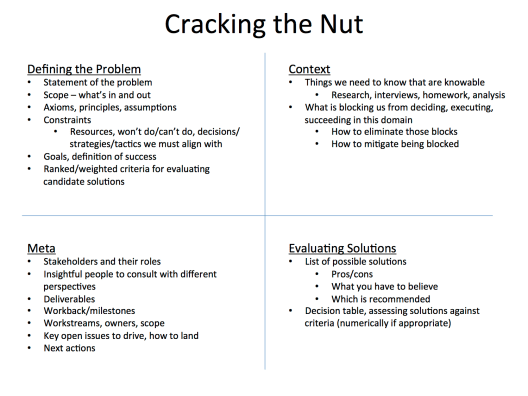
Context

This is the quadrant where we focus on two areas: what we need to know that is knowable and what’s blocking us.

Know What Is Knowable

As we saw in Part 2 (link), there is a big debate within Slimy Inc about the potential size of the kid’s slime market and our ability to generate revenue in the commercial slime market against the dominance of BigSludge.  While these are both predictions about the future and hence cannot be perfectly known, they are subject to analysis.  By bringing some data into the conversation, we can help reduce the uncertainty around the value to assign to these criteria for our various options.

Figuring out the potential kid market is probably the hardest problem.  There is always a lot of risk in any new kind of product, but we can do many kinds of analysis to get insight: look at comparable products that we would be competing with/displacing, consider which channels we could use to go to market and how hard it will be to break into them, look at the historical ramp of comparable products, and so forth.  Beyond analysis, we need to actually get into the market and mix it up in the real world with some customers and partners.  We could sell samples through a handful of selected toy stores, or give some away to kids and get their reactions, or do a limited advertising campaign and see what kind of response we get.  The key thing here is, as Steve Blank says, to get out of the building.  All of these tests will give us some data about how much our target audience will actually want our product, what market size we could aspire to, how to build our sales at what cost, and how quickly we could expect it to grow under best/average/worst case.

The other question should be easier to answer – we probably have a lot of insight into our ability to compete with BigSludge, because we have products in market and have been selling them.  There is always the possibility of some brilliant new stroke that changes the game, but in the absence of that kind of insight, we probably know the channels, the costs, the margins, and the levers that exist in the current business.  So we can estimate with some degree of accuracy how much revenue/margin we can generate doing the kinds of things that are conventionally done.  If somebody has a clever idea for disruption, we should do some analysis/investigation to get a sense of how much to expect from it.

The net of these exercises should be some real data on what we can expect under a variety of different assumptions.  That helps assign a value to each criterion for the proposal under consideration.  Think about each one and ask whether you are ready to assess the proposals against it, or if you need more information to do it as well as possible.

Know What’s Blocking the Decision

Many things can block the ability to make a decision aside from the inherent uncertainty about what to do.  In our case, after thinking it through, we realize that there are three:

  1. This decision is supposedly owned by the VP of marketing, but everyone knows that he doesn’t have the authority to make it stick.
  2. One of the original founders of Slimy Inc., who is very influential, is hell-bent on going into the kid slime market.  He’s going to reject any plan that doesn’t focus on that.
  3. The possibly acquisition of Slimy by BigSludge is really distracting senior management.  They aren’t sure how aggressively they want to go after BigSludge until that’s landed, so they will be reluctant to rock the boat.

Any of these three things could torpedo our whole effort.  There is no point in beavering away and coming up with a great answer, if nobody is going to pay attention or act on it.  So we have to get all three resolved in some fashion, or we need to reconsider if there is any point to the whole project.

Meta

That leads us to the “housekeeping” quadrant – all the scaffolding we need to drive the project.  There are a series of important questions we need to think through:

  • Who are the stakeholders and what is their role?  Who can make the decision and make it stick?  Who needs to be consulted before the decision is landed?  Who can veto it?  Who needs to know after we’ve landed it?
  • What are we delivering?  A deck?  A presentation?  A document?  To whom?  When is it due?
  • Workback/milestones – are there any needed steps along the way?  Maybe an early review where we present progress and get feedback?
  • Key open issues – from our analysis so far, we should have a pretty good idea of the open issues – list them, get them owned and driven and landed.
  • Workstreams – are there any sub-projects that have a life of their own and need to be owned/driven?  Maybe that analysis of the kid market, which might involve finding stores and doing trial sales and evaluating results and doing mini-ad campaigns.
  • Next actions – what specific actions need to happen next?  Who will do them?

That’s the heart of the analysis.  In the next post, we’ll wrap it up and land the decision.

Cracking the Nut (Part 2) – Tackling a Messy Problem

In the last post, we used the model to analyze a constrained problem.  Now, we’ll take on something a lot more open ended.

We work for Slimy Inc, an upstart company in the hotly competitive market for slime.  There is a dominant player in the market – BigSludge – and we are trying to figure out how to compete with them.  The traditional slime market is focused on commercial uses, and we’ve been having a tough time competing with BigSludge because they are the market leader and far larger than we are.  But, we’ve created some innovative new slime for kids to play with – a radical development in the slime market.  We’re definitely going to be first to market, though we have heard that BigSludge has a team investigating toy slime.

There is a raging debate within Slimy, Inc about how to compete with BigSludge.   Some people want to continue going after them head-on in the large commercial market, relying on our superior products.  Others want to put all the company’s efforts into the new kid slime product line (but is there really a big enough market, and will it develop soon enough?).  Another faction is pushing for an acquisition – BigSludge knows about the cool new products we’ve come up with, and they’ve had a couple of discussions with our leadership team about it.  As usual, there are dozens of variations of these basic ideas, and they’ve gotten tangled up with each other.  Emotions are running high and discussions have been going around in a circle.

We’ve been asked to take on this problem, analyze it, and get the decision landed.  The stakes are high – the decision will probably determine the future of the company and perhaps its very survival.  So, it’s time to get methodical.

Defining the Problem

We start here, as always.  The problem may seem obvious, but often the various stakeholders in the conversation have quite different notions.  So we’ll start with a statement of the problem, and it’s incredibly important that we write it down.  There is a great quote by Leslie Lamport, a well known computer scientist: “we write things down in order to realize how poorly we understand them.”  In our case, we land on this: “what strategy should Slimy use to compete with BigSludge?

Looking at the other tools in the quadrant, there are a couple that will be helpful.

Scope – what is in and out of scope for our problem solving effort?  In this case, let’s put the decision to pursue acquisition out of scope – that’s an interesting analysis, but it’s pretty separate from figuring out how to compete.  Our project may provide good insight, though: if we can’t come up with any compelling way to compete, then we may have a lot more enthusiasm about acquisition.  But we’ll confine our scope to competing with BigSludge.  We also have to make sure we get the key people to agree on our proposed scope!

Assumptions, Axioms, and Principles – I think of these as the foundation of the analysis, and they are incredibly useful to work through and write down.  They are related notions, but I try thinking about all of them to see which are most relevant to the problem at hand.

  • Assumptions – something you believe to be true, but you are aware that you might be wrong.  “There is a large potential market for toy slime that BigSludge will not be able to address for at least three years”.  Once you’ve identified your assumptions, you can decide how risky they are, how much your potential wrongness could hurt you, and hence how much you need to validate them.
  • Axiom – “a self-evident truth that requires no proof” – you simply accept an axiom without debate or validation.  In our case, an axiom might be “commercial slime is an essential need for current customers and nothing will replace it in the market during the next ten years.”  Your axioms can save you a lot of time, since you don’t need to bother analyzing them.  But, they are obviously dangerous, because if you are wrong about them, you can choose a really bad path.  DEC had an axiom that PCs weren’t a threat because they were too small to do “real computing” – and DEC paid dearly for that axiom by going out of business and being acquired in a fire sale by one of those scorned PC makers.  So one of my main reasons to poke on axioms is that groups generally have a set of them that are accepted unconsciously and unquestioningly.  It is worth teasing them out and stating them explicitly to make sure that they really should be axioms, and are not just questionable assumptions masquerading as revealed truth.
  • Principles – a core belief that you are going to follow.  Ex: “we will produce no toxic by-products in our manufacturing processes” or “we will tell every customer the turnaround for any order within 2 days of accuracy.”  Principles help you be clear about what you believe in, and they guide you in terms of what solutions you are willing and able to consider.

Goals and Defining Success – often when people are disagreeing about a course of action, it is because they don’t agree on what “success” means.  Are we trying to achieve a good ROI on our product development investments? Establish ourselves as the share leader in a new market?  Win share from BigSludge in the current market?  Grow revenue or profit by a certain amount?  Survive as a company?

I have found it best for the goal of a project like this to be succinct and measurable.  I also prefer if the goal

  • Doesn’t pre-suppose a particular strategy.  In our case, if we define the goal to be “create a large new market for slime”, then it heavily influences the approaches we can use to get there.
  • Is defined positively, not negatively.  I much prefer “radically increase our revenue and profitability” vs. “take share from our competitor”.  The negative approach can lock you into a zero-sum mentality, rather than creatively looking for any way to achieve your true goal.  Presumably what you really want is to make massive amounts of revenue and profit, regardless of what your competition does.

For our purposes, we will use this: “a successful strategy will yield a set of quickly growing product lines in the market that have higher profitability than anything we currently sell.”

Constraints – we are always under many constraints and we need to understand how they limit our options.  They might involve resources (money or people), legal requirements, etc.

Solution criteria – just like we did in the last post, we will need to come up with a ranked set of criteria for evaluating our options.  This is often the hardest part of defining the problem; fierce disagreements are often disguised arguments about the criteria.  For example, we have one group that wants to tackle BigSludge head on in their core market, which is large and well established.  Another wants to dedicate the company’s resources to expanding into the new kid slime market.  What’s going on?

The real challenge is that there are competing (and valid) criteria to judge potential strategies.  In this case, they are:

  • Size of the target market – one group questions whether the kid market is real and large.  There is no question that the current market is large.
  • Growth of the target market – the current market is mature and is growing with GDP.  We don’t know of anything on the horizon that will change its trajectory (per our axiom above).  The future of the kid market is much harder to predict; if the company can really nail an offering, it could be a huge and high growth market.  Or, it could stay tiny because only the early kid adopters will ever bother playing with slime.
  • Riskiness of our market prediction – obviously one is not risky in terms of its existing, the other is high risk.  Also, BigSludge has that research group that might get a clue and develop a competing offering in the kid market – it’s unclear how long we can have it to ourselves.
  • Ability to capture target market – to get the traditional market, you have to find a way to compete with BigSludge and take share or expand the market somehow.  The company probably has a pretty good sense of how hard this will be and has some ability to execute on it, but it may be very difficult to succeed.  To create a whole new market, even if the demand is there, calls for specialized skills and new partner relationships and the like.  Does Slimy have what it takes to pull this off?

The disagreement between the two groups is a disagreement about the value to assign to each criteria and the relative priority of the criteria.  This is really key to understand.  Until you start digging at the real basis of the disagreement, you will often go around in circles and everybody will just get locked more deeply into their point of view.

The faction that wants to go after the traditional market believes that (a) the opportunity in the kid market is small and will stay small, (b) betting on that market is much too risky and will take a lot of energy to pursue, and (c) Slimy doesn’t have what it takes to create new markets.  The other group believes that (a) the kid market has huge potential, that (b) it will grow quickly, (c) Slimy is in a good position to take a risk for huge upside, and (d) the company can learn how to sell to a new audience.  They also (e) doubt whether Slimy can compete effectively with BigSludge in their core market.  So the two groups differ on:

  • The value to assign to a criteria: is the kid market going to be large and high growth or small?   Can Slimy really make headway in the traditional market?  These questions can’t be answered perfectly, of course, since you are predicting a future outcome.  But you can certainly get data to support the analysis.
  • The relative priority of the criteria.  One group is risk-averse, the other isn’t.  This is a useful debate – how much risk is the company willing to take on?  What kinds of risk?

The key thing you can do with an analysis like this is move the debate from an unproductive place – “We should go after the kid market!” “That’s crazy, we should go after the money, and that’s in the commercial market!” – to a much more useful discussion around the real issues – can we get facts to assign values to the criteria more confidently, and how should we prioritize competing values?  These are still very hard questions, and they still require us to make decisions in the face of uncertainty.  But they let us focus our energies on reducing the key points of uncertainty and on having debates that we can actually settle.

We’ve now got the foundation in place for our problem solving effort – we know the problem to solve and its scope, we know what our goal is, we have articulated our principles and assumptions, and we know how we’re going to evaluate possible courses of action.  Next, we’ll move on to other quadrants of the model.

Cracking the Nut (Part 1) – How to Make Almost Any Decision

One of my favorite challenges is to take on a really hard complicated problem .. and figure out how to move forward based on a compelling and rigorous analysis.  Best of all is to do it with a small group of kindred spirits.  In a team that I was part of for many years, we called this process “cracking the nut”, and over the years I’ve developed a model for tackling a new problem.  I thought I’d share it in a series of posts, applying it to a couple of examples.

Getting Started

For the first example, let’s pick something straightforward and personal, but potentially hard: choosing among a set of job offers.  This diagram outlines the model (you can download a full sized version here):

Define the problem

Let’s dive in.  The first thing to do is make sure that you really define the problem.  For our job conundrum, that’s pretty easy: “figure out which of my job offers is the best”.  Of the tools in this quadrant, there is one that is really going to be helpful for us: decision criteria.  In other words, what actually matters about the new job.  There are many factors that might matter.  One team works in a really cool office, another is located in a great neighborhood, another is working on an exciting project, another has a dynamic leader, etc.  Those are all potentially legitimate reasons to pick one over the other .. the question is, what matters to you?

It can be quite hard to figure this out – you have to become a bit of a detective, because often your emotions will lead you to over- or under-weight different criteria vs. how they will truly affect your life.  One way I get started is to list all the characteristics that spring to mind about each of the jobs.  Then winnow down to the ones that I think are the most important.

Let’s say you have done this and came up with four rank ordered criteria.  You will probably be inclined to have more, but try to keep the list short – priorities get watered down if you have a lot of them.

  1. Impact of the project
  2. How skillful I am at the work
  3. Salary
  4. Work/life balance

Challenge yourself a bit here.  Think back on when you were happiest and most engaged in your work, and ask if that is really reflected by the criteria you picked and the order you put them in.  “Let’s see .. I loved my job on the WickedCool project.  Why?  Well, the woman running the project was amazing and inspiring.  I got to dive in to a bunch of new areas I’d never done before.   I worked like a dog, but it was so fulfilling to see the project ship and touch so many people’s lives.”  And think about counter-examples.  “I was miserable working on the Grumble project.  Nobody was inspired by what we were doing, it was the fifth version of a minor product.  I got home for dinner every night, but I just dragged myself through the day.”

Now, do the things that popped out as great or bad match your original criteria?  No, not really.  An inspiring leader and team didn’t make your list, but that was critical in both WickedCool and Grumble.  Work/life balance was lousy when you were happy, and good when you were miserable.  Salary didn’t come up.  And if you were learning all the time on WickedCool, you were probably lame at your job for a fair amount of time in the beginning.  But the impact point did make the list.

So perhaps this is a more accurate set of criteria:

  1. Inspiring leader/inspired team
  2. Impact of the project
  3. Chance to learn new skills

Keep going, keep challenging yourself.  Pose hypotheticals – if I got offered a job working for somebody great who is doing something I don’t care as much about, would I take that rather than working for a less exciting person on a project that inspires more passion?  Another good tool is to demote a criterion to a constraint.  You might need a certain salary in order to support your family, but as long as you make that much you won’t prioritize one job over another because the first one pays better.

Again, the whole point in a personal decision like this is to figure out what really matters to you.  Not what is supposed to matter.  Not what matters to your inner critic or your mother or would impress that teacher who liked somebody else better.  To you.

Context

This quadrant focuses on what you need to understand better in order to make the decision.  You want to focus on things that will actually affect the decision, are not known, and are knowable within a time frame that is relevant.  In the case of the job hunt, you’d look at the criteria that we identified above, and see whether you actually do know how the different job options stack up, and if you can know.

Take “inspiring leader/inspired team”, for example.  If you went through a whole set of interviews with people on the team, then you should have a decent read on that one.  But if it’s one of the most important things to you, then it may be worth digging some more.  Maybe you can take somebody on the team out to lunch and explore it more informally.  If they are offering you a job, they want to sell you – it’s a big investment of their time to find somebody and make an offer, so they will presumably be motivated to encourage you to join.  If not, that’s a potential red flag – you learned something even by being turned down.  Talk to somebody who works with them and whose judgment you trust, if possible.  Talk to somebody who left the team.  Do the best you can to figure out how a team or company or neighborhood or whatever really stacks up on your key criteria.

Meta

This quadrant covers the project management aspects of the decision.  In the case of picking a job, it might not be too complicated.  But, there may be other stakeholders (do you have a spouse/family/etc who would be affected if you picked one job over another?).  You probably have a deadline – the date by which you need to make a decision.  There might be a workback, in the sense that you have to notify your current employer/team, or you have to negotiate salary, or you need to sell your house or give up your lease or whatever.  Make sure you have all of these aspects captured.

Evaluating Solutions

Now that you have done your research, go back to your set of options, and test them against your criteria.  You’ve spent a bunch of time figuring out what truly matters to you, so focus on that – don’t let surface things that influence you emotionally take precedence.  You definitely shouldn’t ignore your emotional reaction – a gut feel that something is wrong is always worth listening to.  But, a gut feel that you will be a much cooler person if you work for a company in a particular area code should be given the importance that it deserves .. whatever that happens to be for you.  Now you can really stack up your options with a clear idea of how to evaluate them, and figure out which one is the best choice for you.

So that’s an example of using the framework to make a constrained decision.  Next, we’ll give it a spin on something much more open-ended.

Five favorite books .. of insight from unexpected places

I’ve found many intriguing ideas about teams and projects from books on seemingly unrelated subjects.  I’m convinced there are universal principles that can be used in any environment for virtually any goal that you set your mind and heart to achieve.

Dance Choreography

Twyla Tharp is a very well known choreographer who founded her own dance company in 1969 and has performed many works that heavily influenced her field.  She is still active, and in 2003 she wrote a terrific book called The Creative Habit.  In addition to many interesting stories and anecdotes from her long life in dance, it is filled with practical advice on how to organize and carry out complex creative projects (complete with many exercises for you to try).

“The first steps of a creative act are like groping in the dark: random and chaotic, feverish and fearful .. For me, these moments are not pretty.  I look like a desperate woman, tortured by .. a message thumping away in my head.”  She tells us how to go from that stage to performance of a completed dance .. and to keep doing it, as she has, through a long and productive life.

Film-Making

I’ve always been fascinated by the way that movies are made.  I see remarkable similarities between the creation of a movie and a V1 software project.  You have an originating vision that must evolve as you go, you bring together experts in many different disciplines who often have trouble getting along, the team must solve very challenging design problems, and there is a long period of refining the raw material into a polished and compelling final product.  There is often a tense relationship between the creators and the funders, and the final outcome is the product of many people’s contributions rather than being completely under the control of any single person.

William Goldman is one of the most successful screenwriters in the industry.  He wrote many famous movies, including Butch Cassidy and the Sundance Kid and All The President’s Men.  He’s also written some of the best books about the movie business, including Adventures in the Screen Trade and Which Lie Did I Tell?  Check out either one to learn about making movies (with great anecdotes about famous movies and the often deeply odd people who make them).  One of his well known mantras is: “Nobody knows anything”.  By which he means, nobody has a clue how a movie will do until it is released – the expectations of the most experienced movie makers are routinely confounded.  The same can be said about radical new software products!

Poetry

I really like to read poetry, which can often be a rich source of introspection and insight.  Catching Life by the Throat, by Josephine Hart, lets you read some wonderful poems and learn about the poets who wrote them.  What I love about the book is that it captures the energy and excitement of a great poem and conveys some of the all-consuming passion to create.  “I was a word child, in a country of word children, where life was language before it was anything else.”  “Poetry, this trinity of sound, sense and sensibility, gave voice to experience in a way no other literary art form could .. it threw sudden shafts of light on my own soul and drew at least the shadow outline of the souls of others.”  The act of creating anything new springs from passion and is refined through unceasing and painstaking effort.  This is a passionate book about the magic of poetry.

Chess

You may have heard about Josh Waitzkin because of his father, who wrote a fun book called “Searching for Bobby Fisher” about the development of his son into a chess prodigy.  The book, which was also made into a movie, is a fascinating glimpse into the peculiar world of obsessive chess players.  Mostly ignored by mainstream society, the subculture occasionally bursts into view, as it did during the cold war or when its stars were pitted against supercomputers in man vs. machine contests.  Josh had a long period of prominence in the chess world, starting when he won the National Chess Championship at 9 years old.  He then went on to become a Tai Chi world champion as well!

From these experiences, Josh wrote his own book called The Art of Learning.  He shows how he takes on a new discipline and applies the same approach to it that he learned as an obsessive childhood chess player.  He copes with losing, deals with adversity, and is very systematic about achieving an extreme level of skill and ability.  He’s also able to learn from just about anyone – as a child, he got some of his best insight into chess from playing street hustlers and gamblers.  The book is an unusual blend of autobiography and instruction, with a wealth of anecdotes about the extremely different and equally obsessive worlds that Josh has inhabited throughout his life.

Art

I decided to learn how to draw as an adult, and I love doing it.  Many excellent books helped me along, but one stands out particularly when it comes to letting creativity flow (in any field).  Julia Cameron wrote The Artist’s Way to help unblock artists and get their creative juices flowing.  It became unexpectedly successful and the series that it spawned has sold millions of copies.  It does have some new age religious ideology that doesn’t resonate with me, but it is chock full of productive exercises to help you work through blocks and loosen up.  She lays out a 12 week process for breaking through obstacles, finding what really inspires you, and making it happen.  I think that any great achievement starts from a deep passion.  Once you know what you are inspired to do and you begin pursuing it with conviction, you are on the path to a life of meaning.  This book can help you find it.

Have you found insight in unexpected places?